EV charging for local authorities: what councils must decide first
A public charging project rarely fails on technical grounds. It fails on governance: nobody has settled who funds the investment, who operates it day to day, who collects the revenue and who answers the frustrated driver on a Sunday evening.
The hardware question comes last, and rightly so. Yet it tends to dominate discussions long before those four answers are written down. A project involving EV charging for local authorities is built against intuition: governance first, civil works next, the charge point last.
Who holds the competence to install charge points?
In France, competence over charging infrastructure sits with the municipality, which may transfer it. The general code of local authorities explicitly provides for that transfer to an inter-municipal public body or to an energy syndicate.
This is no administrative formality. It determines who signs the contracts, who carries the investment and, above all, who has a team able to look after a fleet of charge points over time — that is, long after the ribbon has been cut.
- The municipality keeps the competence and bears both investment and operation alone
- Transfer to the inter-municipal body allows pooling across the wider urban area
- Transfer to the energy syndicate brings engineering capacity and an existing fleet
The master plan, the most underused lever
The French mobility law opened the door for inter-municipal bodies to adopt a master plan for the development of charging infrastructure. The document takes stock of what exists, projects future demand and ranks candidate locations.
Its value goes beyond planning. It gives the project a defensible territorial logic, structures the dialogue with the distribution network operator and conditions access to certain support schemes. An authority without one installs charge points; an authority with one builds a network.
A charge point installed without supervision, without a maintenance contract and without roaming platform membership works for a few months, then fails without anyone finding out. It is the most common failure mode of early public deployments, and the most damaging to reputation.
What the renewable acceleration law changes for public car parks
The French renewable acceleration law requires photovoltaic canopies on outdoor car parks above the surface threshold set by the text. Public car parks fall within its scope.
The practical effect is twofold. A works deadline appears on exactly the surfaces where charging makes sense, and treating the two subjects separately becomes absurd: the same trench, the same grid connection and the same contract can carry both the canopy and the charge points. Splitting them means paying for the civil works twice.
Roaming and billing: the obligations that bind the council
A publicly accessible charge point is not an internal facility. It must remain usable by a driver with no local access card, which means joining a roaming platform such as GIREVE, and publishing a legible tariff in advance.
Once charging is billed per kilowatt-hour, metering falls under legal metrology — that is the purpose of MID certification. Supervision, meanwhile, is not a comfort. Without it there is no reliable rebilling, no power management and no evidence in the event of a dispute. That is the role of a platform such as Spark Pilot, which relies on the open OCPP protocol to stay independent of the hardware installed.
| Delivery model | Who operates | Watch out for |
|---|---|---|
| Direct management | The authority | Requires an on-call rota and lasting in-house skills |
| Service contract | A provider | Pin down availability and response times |
| Concession | The concession holder | Frame the tariff and the fate of assets at contract end |
Funding without straining the capital budget
The Advenir programme, funded through energy savings certificates, includes a strand dedicated to local authorities. Regional schemes and ADEME calls for projects can be added, provided they are processed before any spending is committed — a scheduling point that regularly disqualifies otherwise solid applications.
The cost of EV charging for local authorities is not limited to hardware. Civil works, grid connection, supervision and maintenance weigh more heavily across the asset's life. A credible case presents a total cost over the depreciation period, not a purchase price.
The six decisions to settle before going to tender
- Who holds the competence: the municipality, the inter-municipal body or the energy syndicate
- Who operates and who covers the on-call rota, weekends and public holidays included
- What power per charge point, measured against actual observed dwell time
- What tariff, and whether it applies per kilowatt-hour or per hour
- Which roaming platform and which supervision protocol
- What total cost over the depreciation period, civil works included
These six answers fit on a single page. They nonetheless determine almost the entire specification, and their absence explains most of the degraded public networks visible today.
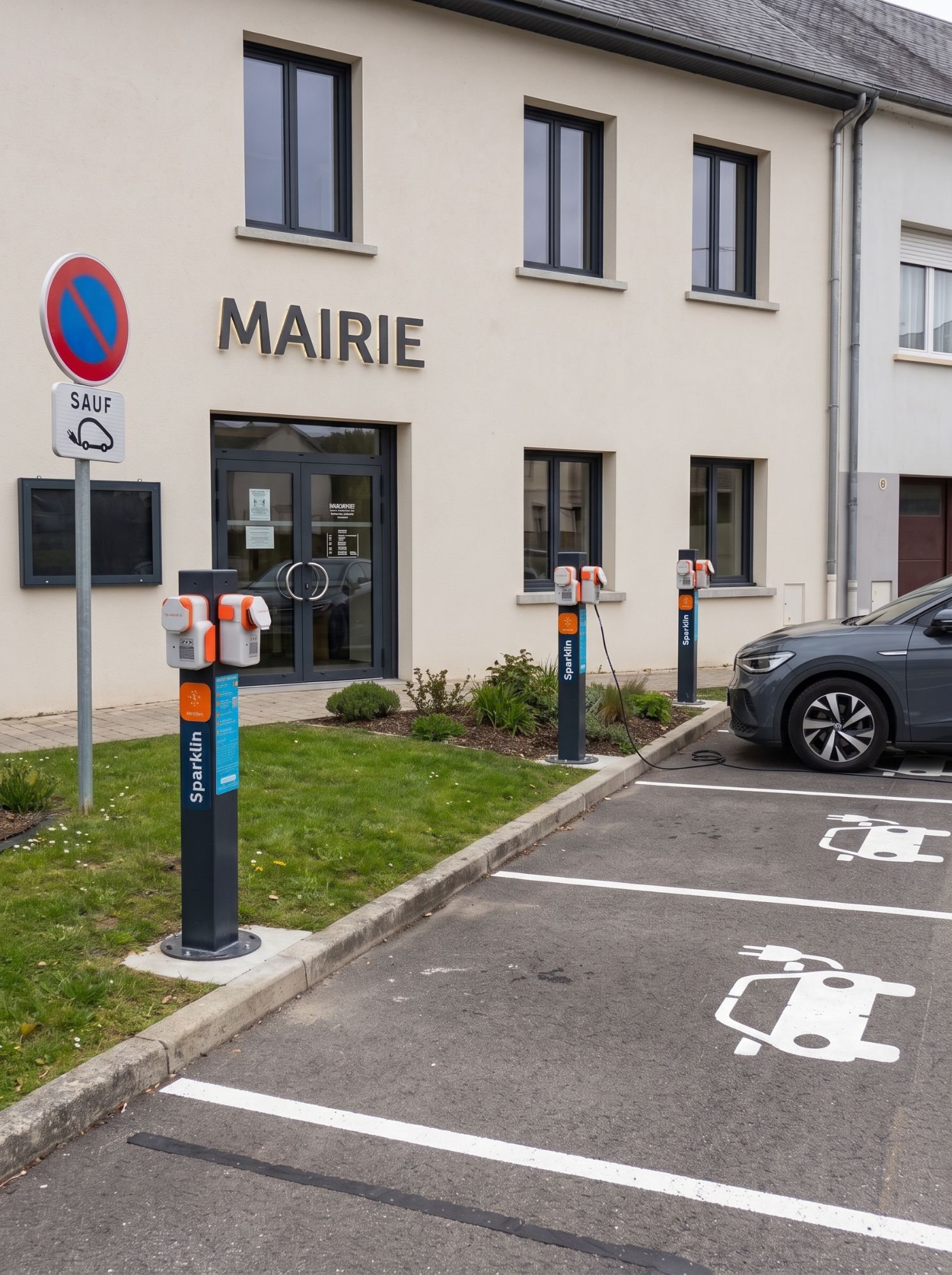
On long-dwell spaces — town hall, community hall, park-and-ride, sports facility — a managed alternating-current charge point such as Spark 1 on a bollard, or Spark Plus, covers the bulk of use cases without forcing a grid connection upgrade.
Tell us how many spaces you are targeting and the delivery model you have in mind: we will tell you what is feasible without upgrading your grid connection.
Talk to our team