Load balancing : 50 bornes sans renforcement EDF | Sparklin
Qu'est-ce que le load balancing en IRVE ?
Le load balancing — ou répartition dynamique de puissance en français — est un mécanisme logiciel qui pilote en temps réel la puissance électrique distribuée à chaque borne de recharge d'un même site. Contrairement à une installation classique où chaque borne dispose d'une puissance fixe et invariable, le load balancing adapte en permanence l'allocation en fonction :
- du nombre de véhicules branchés simultanément
- de la puissance résiduelle disponible sur le tableau général du bâtiment
- des priorités paramétrées (flotte > collaborateurs > visiteurs, par exemple)
- des plages horaires définies par le gestionnaire
L'objectif est simple : ne jamais dépasser la puissance souscrite auprès d'Enedis, quelles que soient les conditions d'utilisation du parking.
Sans load balancing, installer 20 bornes de 7,4 kW représente théoriquement 148 kW de puissance simultanée. Avec un abonnement bâtiment de 100 kW, chaque dépassement est facturé 3 à 5× le tarif normal par Enedis — et peut déclencher des pénalités contractuelles.
Comment fonctionne le load balancing avec Spark Pilot ?
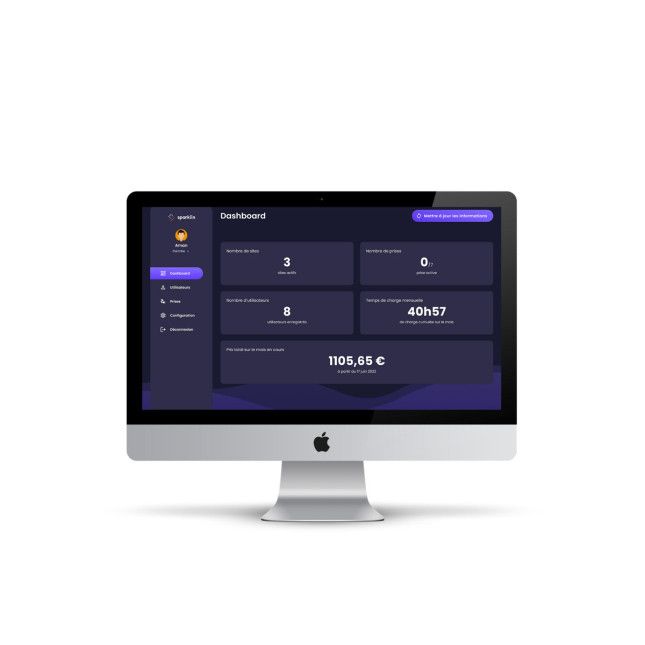
Spark Pilot, la plateforme de supervision Sparklin, intègre un module de load balancing nativement. Son fonctionnement repose sur trois composants :
1. Le capteur de puissance principale
Un capteur téléinformation (ou un compteur communicant Linky) est installé sur le tableau général du bâtiment. Il remonte en temps réel la puissance consommée par l'ensemble du site — chauffage, éclairage, ascenseurs, équipements informatiques. Spark Pilot dispose ainsi d'une vision précise de la puissance disponible pour la recharge à chaque instant.
2. Le calcul de répartition en temps réel
Toutes les 30 secondes (paramétrable), Spark Pilot recalcule la puissance allouée à chaque borne active. L'algorithme applique la règle : puissance disponible recharge = puissance souscrite − consommation bâtiment en cours − marge de sécurité. Cette puissance est ensuite répartie entre toutes les bornes selon les priorités configurées.
3. La communication OCPP 1.6J
Les bornes Sparklin (Spark 1, Spark Plus) communiquent via le protocole OCPP 1.6J avec Spark Pilot. C'est ce canal qui permet à la plateforme d'envoyer les consignes de puissance en temps réel, et aux bornes de reporter instantanément leur consommation effective. La latence de bout en bout est inférieure à 500 ms.
Exemple concret : 50 bornes sur un site de 200 kVA
Prenons un cas réel de déploiement Sparklin chez un client industriel en Île-de-France :
| Paramètre | Sans load balancing | Avec Spark Pilot |
|---|---|---|
| Bornes déployées | 50 bornes 3,7 kW | 50 bornes 3,7 kW |
| Puissance théorique max | 185 kW | 185 kW |
| Renforcement contrat Enedis | +185 kW requis | 0 kW |
| Coût travaux génie civil | 35 000 – 80 000 € | 0 € |
| Dépassements Enedis/an | 12 à 18 épisodes | 0 |
| Économie annuelle estimée | — | 9 000 – 15 000 €/an |
En pratique, sur ce site, jamais plus de 22 véhicules ne rechargent simultanément à pleine puissance (taux de simultanéité : 44%). Spark Pilot répartit les 200 kVA disponibles entre ces 22 bornes actives, garantissant en moyenne 9 kW par véhicule — soit une recharge complète en moins de 5h pour la plupart des véhicules de flotte.
Quel impact sur la facture électrique ?
La facture électrique professionnelle en France (tarif HTA ou BT > 36 kVA) se décompose en deux postes principaux :
- La part énergie : le coût des kWh réellement consommés — cette part augmente mécaniquement avec la recharge électrique, mais de façon prévisible et maîtrisée.
- La part puissance (terme fixe) : le coût de la puissance souscrite auprès d'Enedis. C'est ici que le load balancing fait toute la différence.
Sans load balancing, une entreprise qui déploie 30 bornes de 7,4 kW doit souvent augmenter sa puissance souscrite de 100 à 180 kW — ce qui se traduit par une hausse du terme fixe annuel de 8 000 à 14 000 €, indépendamment de la consommation réelle.
Avec Spark Pilot, cette augmentation est nulle ou marginale. Le ROI de l'abonnement Spark Pilot (à partir de 1 200 €/an pour un site) est généralement atteint en 3 à 6 mois par les seules économies sur la part puissance.
Load balancing statique vs dynamique : quelle différence ?
Il existe deux approches de load balancing, aux performances très différentes :
Le load balancing statique
La puissance maximale est divisée par le nombre total de bornes et assignée de manière fixe. Exemple : 100 kW / 20 bornes = 5 kW par borne, en permanence, que les voitures soient branchées ou non. Simple à mettre en œuvre, mais très inefficace : les bornes inoccupées "bloquent" de la puissance inutilement.
Le load balancing dynamique (Spark Pilot)
La puissance est répartie uniquement entre les bornes actives, en temps réel. Si seulement 8 bornes sur 20 sont occupées, chacune reçoit 100/8 = 12,5 kW au lieu de 5 kW. Les véhicules rechargent 2,5 fois plus vite pour un coût global identique. C'est le standard adopté par Spark Pilot et requis par la norme OCPP 1.6J.
- Puissance fixe par borne
- Inefficace si taux d'occupation variable
- Simple mais coûteux en puissance
- Ne tient pas compte des autres usages du bâtiment
- Puissance ajustée en temps réel
- Optimisation continue selon usage réel
- Intègre la consommation bâtiment
- Conforme OCPP 1.6J — interopérable
Obligations réglementaires LOM et load balancing
Depuis le décret LOM 2021-1246, tout déploiement IRVE sur un parking de plus de 10 places doit inclure une gestion de l'énergie permettant d'éviter les dépassements de puissance. En pratique, cette obligation se traduit par l'obligation de déployer un système de load balancing dès que plusieurs bornes partagent la même source d'alimentation.
À partir de juillet 2026, les contrôles DREAL seront actifs et pourront infliger des amendes jusqu'à 75 000 € par parking non conforme. Un parking équipé de bornes sans pilotage intelligent expose donc son exploitant à un double risque : financier (dépassements Enedis) et réglementaire (amendes LOM).
Checklist avant de déployer vos bornes
Avant de lancer un projet IRVE, voici les questions à vous poser pour évaluer votre besoin en load balancing :
- Quelle est la puissance souscrite actuelle de votre site ? (sur votre facture EDF/Enedis, en kVA ou kW)
- Quelle est la puissance de pointe actuelle du bâtiment ? (à demander à votre gestionnaire technique)
- Combien de bornes prévoyez-vous de déployer ? et à quelle puissance unitaire ?
- Quel est le taux de simultanéité estimé ? (généralement 30 à 50% sur un parking d'entreprise en journée)
- Y a-t-il des pics de consommation prévisibles sur votre site (arrivée des collaborateurs le matin, départ le soir) ?
Si la puissance cumulée des bornes dépasse 50% de votre puissance souscrite, le load balancing dynamique est indispensable. Sparklin propose un audit de puissance gratuit qui répond à toutes ces questions en 48h.
Nos ingénieurs réalisent une simulation de répartition de puissance gratuite, basée sur votre profil de consommation réel.
Demander une simulation gratuite →